
When most people think of paintless dent repair, they imagine a technician using tools to physically move metal back into place. While that is technically what happens, it is the smallest part of the job. For a master technician, the real work happens in the eyes and the mind.
At The Ding Guy, we often tell our students that PDR is 90% optics and 10% metal. If you cannot see the damage with absolute precision, you cannot fix it. Mastery isn't about strength; it’s about learning to read the language of light and shadows reflected off a vehicle’s surface.
In this second installment of our PDR School series, we explore the visual philosophy that defines high-level pdr training in Colorado.
Why do your eyes lie to you when looking at a dent?
If you look directly at a dent on a car door, your brain sees a "hole" or a "ding." However, the human eye is not naturally equipped to measure microscopic variations in flat, glossy surfaces. Your brain fills in the gaps, often hiding the most important details of the damage.
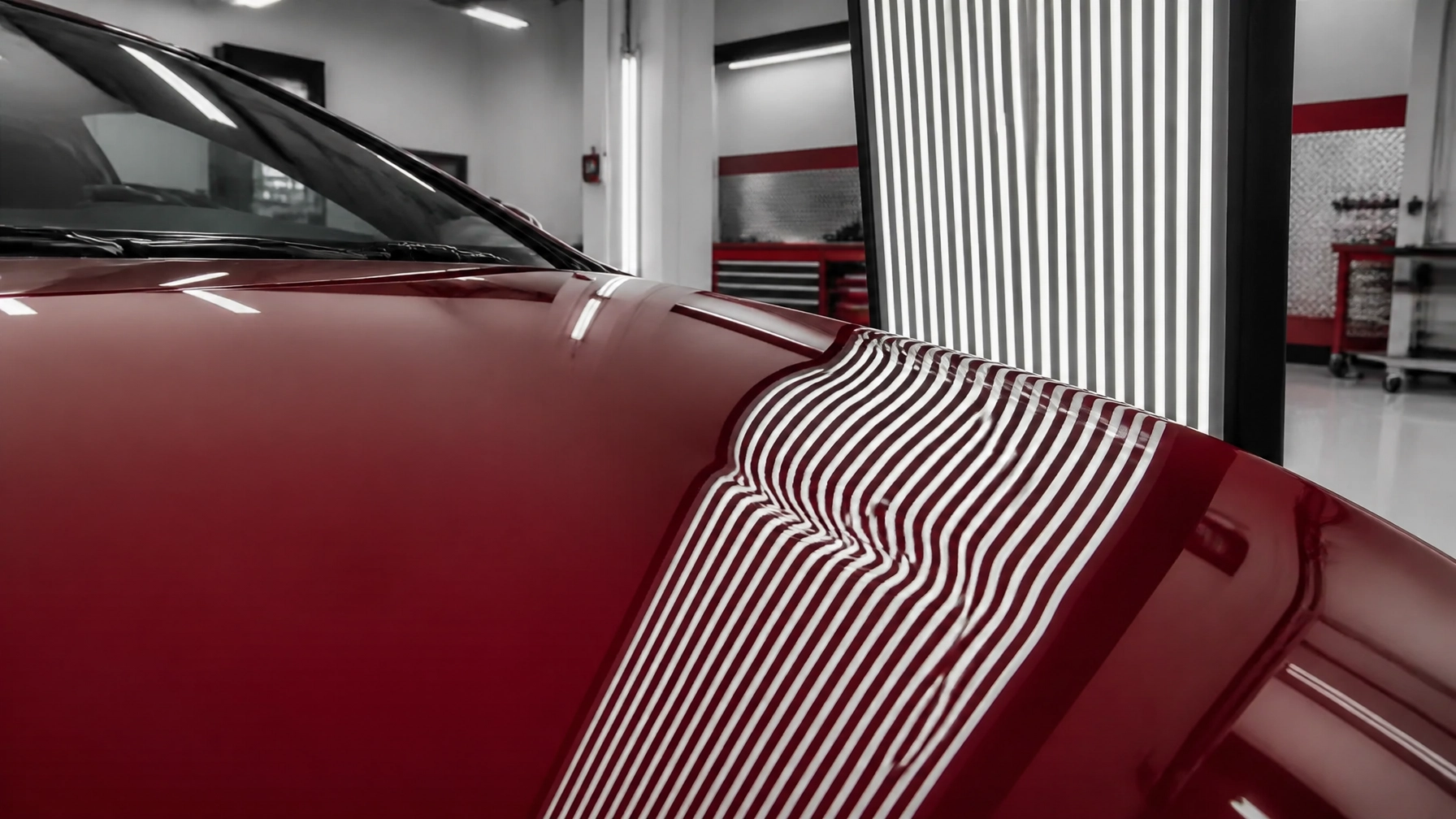
To overcome this, we use optics. By introducing a controlled light source: such as a line board or a fog light: we transform a confusing surface into a clear, topographical map. We don’t look at the dent; we look at how the dent distorts the reflection.
What is "reading the metal like a map"?
Imagine looking at a topographic map of a mountain range. You can see the peaks (highs) and the valleys (lows) through contour lines. In PDR, the reflection of a light board acts as those contour lines.
- The Valleys (Lows): These are the actual dents. In a reflection, these areas cause the light patterns to "spread out" or splay.
- The Peaks (Highs/Crowns): When metal is pushed down in one spot, it often creates "crowns" or high pressure points around the impact. In a reflection, these areas cause the light patterns to "pinch" or tighten together.
Learning how to become a pdr tech starts with training your brain to ignore the car and focus entirely on these shifts in the reflection.

Lines vs. Fog: Which optical method is better?
There are two primary ways to "read" metal in the world of professional paintless dent repair. Neither is "better," but they serve different purposes during the repair process.
1. The Line Board (Stripes)
A line board uses high-contrast black and white stripes.
- Best for: Precision and finishing.
- How it works: You look for the "pinch" and the "spread." If the stripes are perfectly parallel, the metal is flat. If they wave or curve, you still have work to do.
- The Mastery Point: Master techs can identify "micro-lows" no larger than a grain of sand by watching how the stripes break.
2. The Fog Light (Gradients)
A fog light creates a soft, diffused glow across the panel.
- Best for: Seeing depth and initial shaping.
- How it works: Instead of lines, you look at shadows. The "fog" creates a gradient. A dent appears as a dark shadow inside the light.
- The Mastery Point: This method allows a technician to see the "texture" of the paint (the orange peel) and ensure that the repaired area matches the rest of the car perfectly.

How does The Ding Guy School teach the "Art of Seeing"?
At The Ding Guy School, our curriculum is designed to rebuild how you see the world. We don't start by putting tools in your hands; we start by training your eyes.
Our training process includes:
- Optic Positioning: Learning exactly where to place your light source relative to your head and the panel. A few inches of movement can make a dent disappear or stand out like a sore thumb.
- Head Movement: We teach students to "track" the reflection. By moving your head back and forth, you can see how the distortion moves across the lines, revealing the exact center of the damage.
- Cross-Checking: Professional paintless dent repair optics involve looking at the damage from multiple angles. We teach you to "cross-check" your work by moving your light 90 degrees to ensure the surface is flat from every perspective.
Why is visual mastery the key to a PDR career?
If you are wondering how to become a pdr tech, understand that the physical part of the job is the easiest to learn. The visual part takes years to master.
The difference between a "good" repair and a "perfect" repair is the ability to see the "textures" of the metal. If a technician can’t see the tiny "crowns" or pressure points, they will eventually cause the paint to crack or leave the panel looking wavy.
A master technician sees the metal move in real-time within the reflection. They are essentially "painting" with light and shadows until the reflection is restored to its original, undistorted state.

Ready to master the optics of PDR?
Learning to "see" is the foundation of a successful career in the automotive industry. Whether you are looking for a new career path or want to add a high-value skill to your existing shop, The Ding Guy offers the most comprehensive pdr training in Colorado.
Our family-owned shop has been perfecting these techniques for 35 years. We don't just teach you how to fix a dent; we teach you how to master the metal.
At the same time, mastery is not just about "seeing" the metal. It is also about documenting the work professionally. That is why our students are trained on the ClaimStinger digital auditing platform, which The Ding Guy licenses to provide added value in the training process. This high-tech, digital-compliance reporting helps bridge the gap between seeing a repair and proving its quality to clients and insurers.
Take the first step toward mastery:
- Explore our curriculum: Visit our PDR Workshops page to see upcoming class schedules.
- Get a Quote: If you have damage on your own vehicle, see how the pros do it by requesting a quote today.
- Ask an Expert: Contact us to discuss how our training can help you launch your career.
Leave a Comment
You must be logged in to post a comment.
Comments 0